Tuesday, June 7, 2011

Great Scots, It's Edinburgh

"Did I hear you mention Calvary Chapel?", the enthusiastic Scottish woman exclaimed, grabbing Kathy's arm. "I go to Calvary Chapel here in Edinburgh!"

Our children both remark that whenever they go out with us, Kathy knows absolutely everyone. It was really a surprise to me, though, to find such a close connection while visiting a downtown museum at St. Columba's Free Church of Scotland, right on the Royal mile at the foot of Edinburgh castle.

The woman, Alison Carter talked with us for a few minutes and told us that her daughter Zoe had just gone to the Scottish Pastor's conference with Brian, where she did child care.

St. Columba's is really interesting. We first passed it on our way up to tour the castle, and I stopped to take a picture of its bright red door. This is just up the street from St. Giles Cathedral, with its statue of Adam Smith out back and Marquis of Queensbury out front.

As I was taking the picture, I noticed that there was a sign on the door, advertising an exhibition about the Christian heritage of Scotland. Since it wasn't open until 2:00, we made a note and planned to visit it after the castle.

Earlier in the Day
After our nice day of rest, Monday found us ready to go at the crack of dawn, walking across town to catch the 8:30 train to Scotland. This was our first non-weekend day in England, so it was interesting seeing the Yorksters heading off to work.

With reservations, we got to sit at the table in the center of the train, so I had a little more room for my legs. Our guidebook said that we shouldn't spend the extra money for a first-class rail pass, but I wish we had; being 6' 5" makes it hard to fit in the standard-class seats.

It was a nice sunny day, and it was fun seeing the country side up the west coast of England and Scotland. We sat next to a newly minted geology PhD named Acher from India who was going up to Edinburgh to go to a conference, and he told us a little about the educational system in the UK.

The trip took about two and a half hours; by noon we were climbing the steep hill from the train station up to the main street, called the Royal Mile.

Most of the main sights in Edinburgh lie along this road.

At the very top if the hill is Edinburgh castle, with its statues of Mel Gibson (sorry, William Wallace), and Robert the Bruce flanking the gates. (Coming up the hill to the castle, the only street performer we saw was a costumed Braveheart, with his face painted blue. Kathy remarked that he even looked like Mel Gibson).

Once we got in line for tickets, the ticket seller took one look at me and asked Kathy how old her father was, so we could get a special rate. (She didn't really ask if I was her father. We did get in for half price; they call it a "concession" rate for reaching such an advanced age.)

The castle tour was really well organized. They gave us an audio headset and as you walked around the castle, you pressed different numbers on the player, to hear about the site you were looking at.

The oldest building in Edinburgh is St. Margaret's Chapel, build by King David I (of Scotland, not the original King David), for his mother in 1130.

On top of the castle is one of the giant cannons of James II named Mons Meg.

Instead of cannon balls, it fired cannon stones, each weighing 300 pounds. Because of the heat, it could only fire about 8 times a day.

Here's the view from the parapet where Mons Meg was set. The water in the distance is the Firth of Fourth. The town on the far shore is Fife.

In the compound, there are several military museums. Here's famous painting called The Thin Red Line.

There were also separate museums for the Royal Scots Dragoon Guards and the Royal Scots museum. It's very interesting to see their take on their history; We in America see the Purtians as brave defenders of religious liberty. Here, the Puritans are the villains.

At the very top of the hill is Crown Square that houses the "Honours of Scotland", the oldest set of crown jewels in the British Isles. You aren't allowed to take pictures, of course, and the entrances leading into and out of the exhibit are bank-vault style, foot-thick steel doors.

In addition to the crown jewels, Crown Square also has the remains of the Royal Palace where James the VI of Scotland (later James the I of England, and the James of the King James Bible) was born to Mary, Queen of Scots. We got to see the little room where James was born.

Leaving Crown Square, we wound our ways down through the dungeons where prisoners of war were kept, including pirates from the Caribbean, and, of course, sailors from those mutinous colonists in New England.

Leaving the castle, we had about an hour to get lunch before we needed to get to the train station. We started to cross the street to check out a Kurdish restaurant, when we saw that the exhibit at St. Columba's was open. This is the church building where the Free Church of Scotland (Presbyterian or Covenanters) has their national assembly each year.

There were about a half-dozen workers managing tables and exhibits inside.

When we talked to Alison, she said that the workers came from all of the evangelical churches in the area, working together to explain about the Christian heritage of Scotland.

Alison mentioned a place we could eat next to John Knox's house. (Knox was the reformer who started the Presbyterian church in Scotland.) We found Knox's house, but never found the restaurant.

Instead, we had lunch at the End of the World where Kathy had carrot-ginger soup, and I had the William Wallace burger.

Sunday, June 5, 2011

A Day of Rest

After a week of non-stop activity, it was nice to sleep in (until 8:00 am) and give our rapidly aging bodies a rest. We just puttered around the house until church started downstairs at 10:30.

Since David Sylvester, the senior pastor was out of town, Ross Holden, the youth pastor, gave the message on the first four chapters of Ephesians.

Ross is a good speaker, and even brought in his own visual effects; a dead trout to illustrate how that without Christ, we are without life and carried by the currents of the world.

After church, we visited with several people in the church.

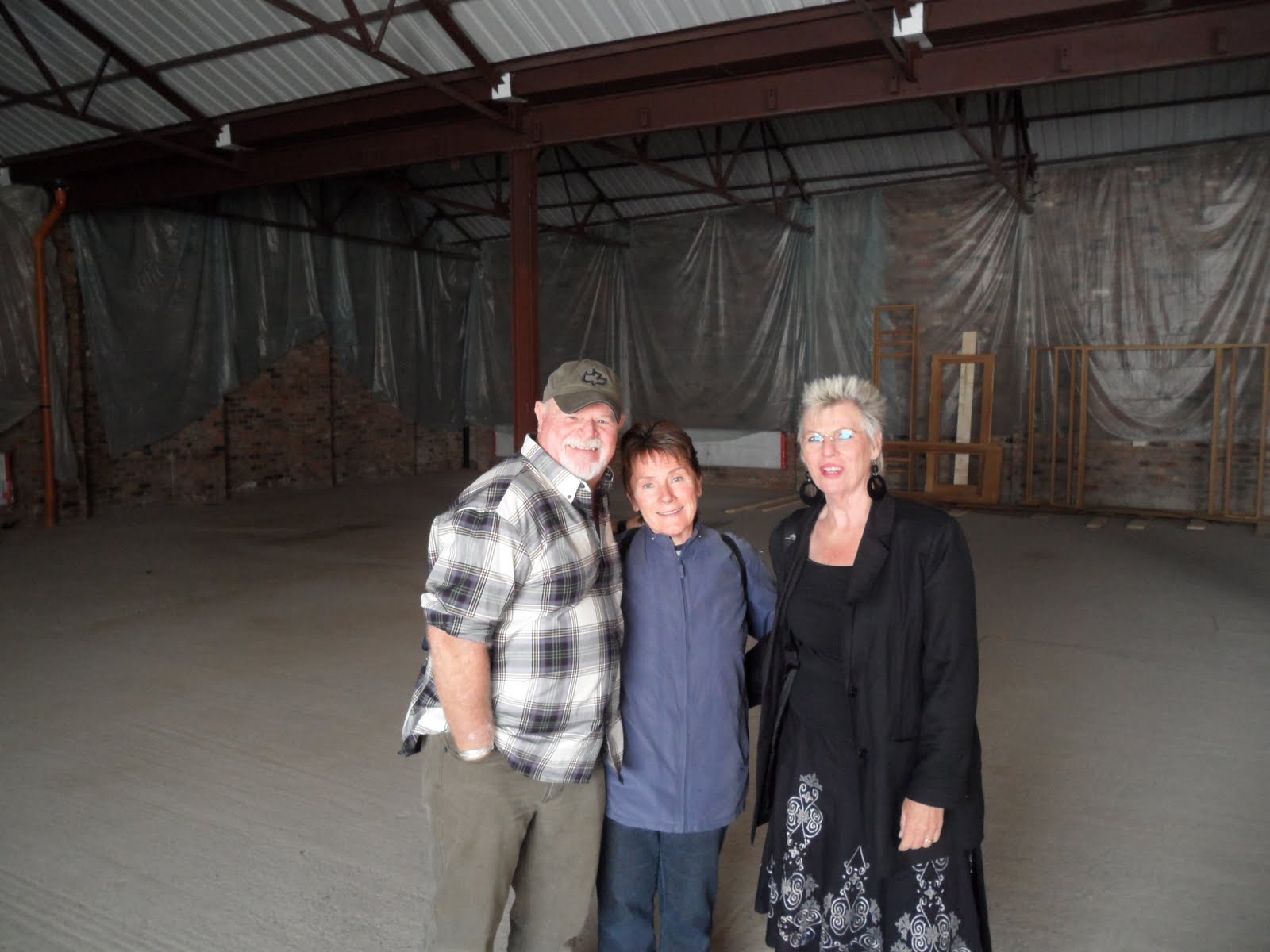
Then, Kirk West showed us around the new sanctuary work being completed next door. Previously it was an old, run-down funeral home; the church has had to rebuild it almost from scratch.

After church, we walked into town for lunch (around 2:00). I got a small York Hogroast sandwich (and got my picture taken with the owner to send to Rick Steves). Kathy, however, wanted "real food", whatever that means.

That was fine with me, though; the problem with eating a Hogroast sandwich is that an hour later you're hungry again.

We ended up having Sunday lunch at a nice little place called Melton's Too. I got a picture of the first course, but forgot to snap a picture of the main course (roast beef, potatoes, Yorkshire pudding and vegetables).

Then, it was back home for a short nap before the evening prayer service at 7:00 pm.

Sunny, Hot and Freezing

"Oh no! I've overslept again.", I thought as a I sat up in bed to the light coming in through the window. I pulled back the curtains and saw the sun dappling the city wall, lighting up the York Minster in the background. A cyclist went riding past.

It was strange, though. Kathy usually gets up an hour or so before me. So, why was she lying there asleep? I decided to give her a nudge and wake her up; I didn't want her to be upset because she'd overslept.

After a few prods, she poked her head out from under the covers and asked what I was doing. I pointed to the window and said that it was time to get up. She pointed to the clock, and said that we'd been asleep for five and a half hours, and to go away.

I got up, made coffee, had breakfast and worked on the blog. About the middle of the day (6:30 am), Kathy got up and did a little email. We set out for our walk around the wall by 7:30.

It was a sunny, very hot, absolutely beautiful day, and we were alone on the wall. We walked past the castle museum (that's Clifford's Tower in the background; I don't know who Clifford is).

We saw several flocks of geese in the parks as we walked on and

crossed the Skeld Bridge over the river Ouse. At the edge of the bridge we picked up the wall again at Bishopgate. This was the location of the original castle built by William the Conqueror in 1069 when York rebelled against the Normans taking over England.

In the "Harrowing of the North", William told his armies to kill every living creature between York and Edinburgh. William was determined to root out Anglo-Saxon culture (the kingdom of Northumbria).

Decades later one of William's supporters would write:

The King stopped at nothing to hunt his enemies. He cut down many people and destroyed homes and land. Nowhere else had he shown such cruelty. This made a real change.

To his shame, William made no effort to control his fury, punishing the innocent with the guilty. He ordered that crops and herds, tools and food be burned to ashes. More than 100,000 people perished of hunger.

I have often praised William in this book, but I can say nothing good about this brutal slaughter. God will punish him.

—Orderic Vitalis, 11th century, The Ecclesiastical history of England and Normandy
Today, of course, William is dead and the descendants of the Yorksters who survived have their picnics on the ruins of his castle.

A little further on, the wall is broken again at the Yorkshire museum and the ruins of St. Mary's Abbey, the legacy of another famous English King.

If any of you have watched the cable TV series, the Tudors, you know that one of Henry the XIII's great campaigns was subduing the power (and grabbing the wealth) of the great monasteries throughout England.

While his Protestant advisers (notable Thomas Cromwell) were perhaps acting out of conviction, it's hard to see the course of the "reformation" in England as other than a political power grab; even though I'm a Protestant, I think that I would have ended up on the side of Sir Thomas More. I mean, after all, the monastery even had a Chapel to St. Stephen.

Leaving the ruins, we rejoined the wall at Bootham Bar, site of the original Roman fortress from AD 300, walking all the rest of the way around the city, back to Walmgate, where our flat was.

Before going back to our flat, we stopped at the Calvary Chapel run Coffee Shop over the Walmgate,

where we ran into Sarah [who used to be a Sylvester] and her husband Dan, both work at the Church and Bible College in York.

After lunch, we decided to use our BritRail pass to do a little sightseeing, and visit Durham, about an hour north of York. While we were waiting for our train, two steam engines came into the station, with hundreds of photographers rushing to take pictures.

We talked to a lady and her daughter, who live in Darlington (about 30 minutes north of York), and she said it was kind of an obsession with the "odd types". They rush around the country, recording the locomotive numbers, kind of like bird watchers.

The trip up to Durham took about an hour (with one stop, in Darlington). Neither of us brought our coats because it was so hot in York; when we stepped out of the train, it must have been twenty-five degrees cooler and heavily overcast. It was like being at Twin Peaks in the fall, and we were both freezing.

Saturday in Durham is kind of crowded; mostly English tourists, I think. There is a market square (where I later had a pork roll sandwich, with stuffing and apple sauce), kind of like one of our swap meets.

At the top of the hill are the Cathedral and the Castle. The Castle is part of the University of Durham.

You can't take pictures inside the Cathedral, which marks the burying place of St. Cuthbert, the monk who was responsible for the famous Lindisfarne gospels, an illuminated manuscript now in the British Library. Here's a picture of Kathy in front of the church door-knocker.

We spent an hour or so walking through the church. There was an art show in the Galilee chapel (surrounding the tomb of the Venerable Bede). We spent some time looking at that because of our daughter Hosanna.

We also saw the head of St. Oswald, one of the first kings of Northumbria. (Actually, to be clear, we saw a plaque marking the location of the head of St. Oswald, not his actual head.)

We wanted to visit the castle, but it was closed. I poked my head into the central courtyard, ignoring the "don't go past this point" signs, so that I could get a picture of the place where part of the first Harry Potter movie was shot. What's an ancient relic compared to that, eh?

The train ride back to York was restful; I fell asleep a couple times. It was only around 6:00, but we decided to stop for dinner in town. Both of us knew that if we made it back to our room, we wouldn't be going out again tonight.

We ate at the Bengal Bazaar; I had the mixed Tandoori, while Kathy had chicken curry and sweet nan.