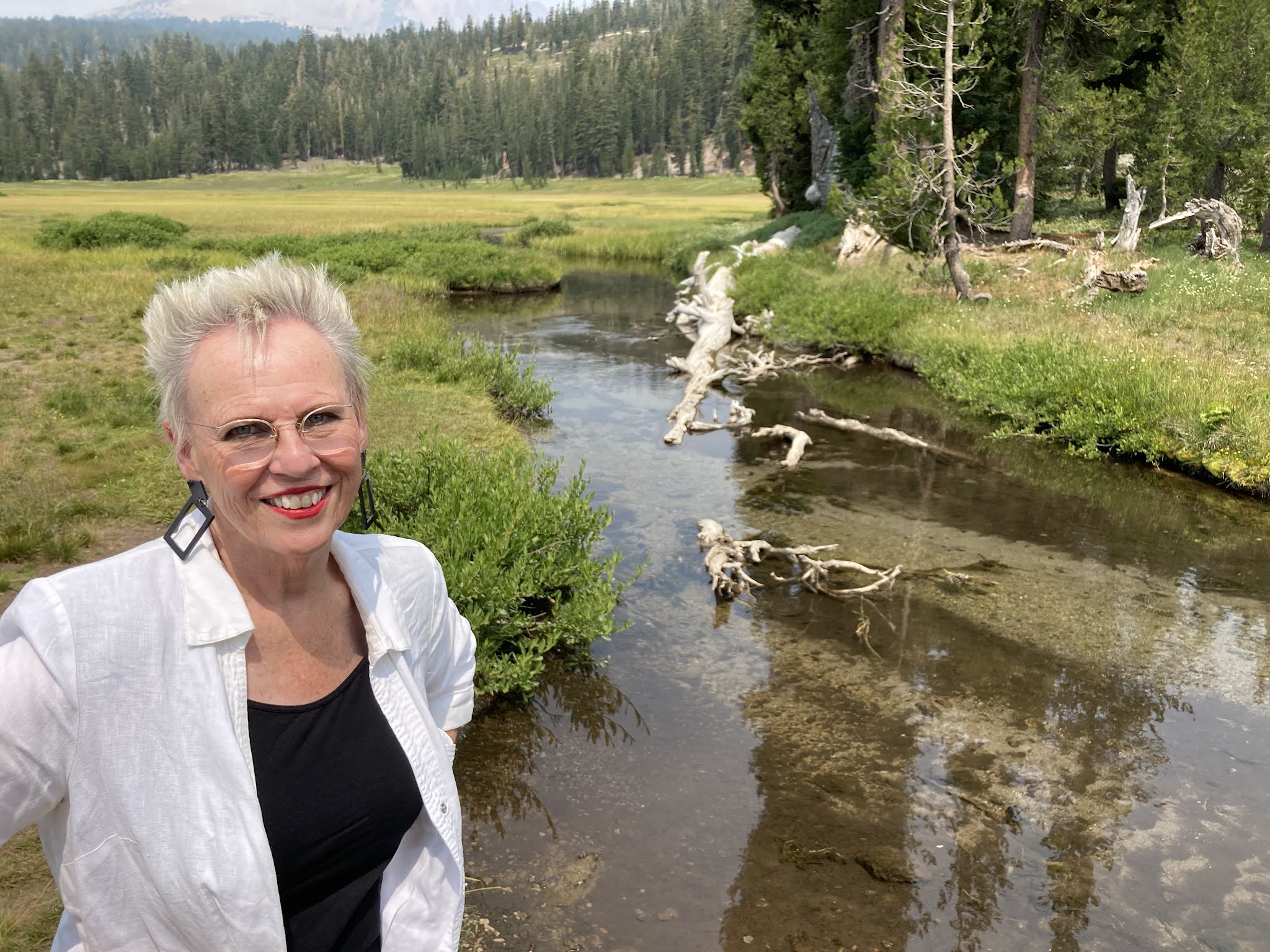
Thursday, July 29, 2021

Poulsbo, Seattle & Spokane


On Tuesday and Wednesday, we drove 750 miles, listening to the 18 disks of Frank Herbert's science-fiction opus, Dune. Hearing Paul Atreides trek across barren Arrakis, where water underlies all of the traditions of the Fremen desert dwellers, it was disconcerting to look out the window and see lush green forests and the open-to-the-sky water of Puget Sound. In any event, listening to audio books makes the driving time much more enjoyable.

On Tuesday morning, we left the Hummingbird Estates at 8:00 after breakfast on the terrace. On our Spring road-trip to New Mexico, all the hotels provided a brown-bag breakfast that was never very appealing. We joked that it reminded us of the breakfast our hotel in Venice provided for us in 2007--a Twinkie and an orange soda. This breakfast was something else: scrambled eggs, sausage patties, home-made hashbrowns and muffins, tangerines and Oregon blackberries. Oh, and coffee. It was great. we really recommend the Hummingbird Estate for an inexpensive, relaxing, romantic get-away.

We got to Poulsbo, Washington around 5:00 pm where we stayed with David & Debbie Grisanti. We all met each other in Shiloh (a Christian communal ministry) in 1970, and we've been friends for over 50 years. David was a teacher at the Calvary Chapel Bible School in Twin Peaks, and then the pastor of Calvary Chapel Silverdale on the Kitsap peninsula, across the Sound from Seattle, for 27 years. Now he runs Ministry Training International, which provides training for pastors and leaders across the world.

We had a wonderful time visiting and wished we could have stayed longer. While we were there, Kathy got to cross "picking blueberries" off of her bucket list.

Wednesday morning, we had an appointment in Seattle to have breakfast with another friend we hadn't seen for over 20 years, Liz (Lober) Li and her husband Skip. We had to leave David & Debbie's house by 6:15 to be sure we caught the 7am ferry to Seattle.

The ferry was a few minutes late but all of Kathy's fears (joke folks) that we'd miss it were unfounded. The weather was sunny and clear instead of rainy and foggy. I can see why summer visitors would decide to move to Seattle.

Driving through Seattle was a bit of a nightmare for me (since I actually don't drive very often). But with Kathy navigating, after about a half hour we found Liz & Skip's house in Seattle's U District, and he came out and directed us to a parking space they'd prepared behind their house.

Although we'd known Liz for 40 years, (she was the Director of Marketing at Maranatha Music when Kathy and I both worked for Calvary Chapel), we'd never met Skip. He's a lawyer and the founder of a well known private land-reform ministry in Central America named Agros. When we arranged to meet them, Kathy and I both read his book, Buy This Land, which was fascinating. 
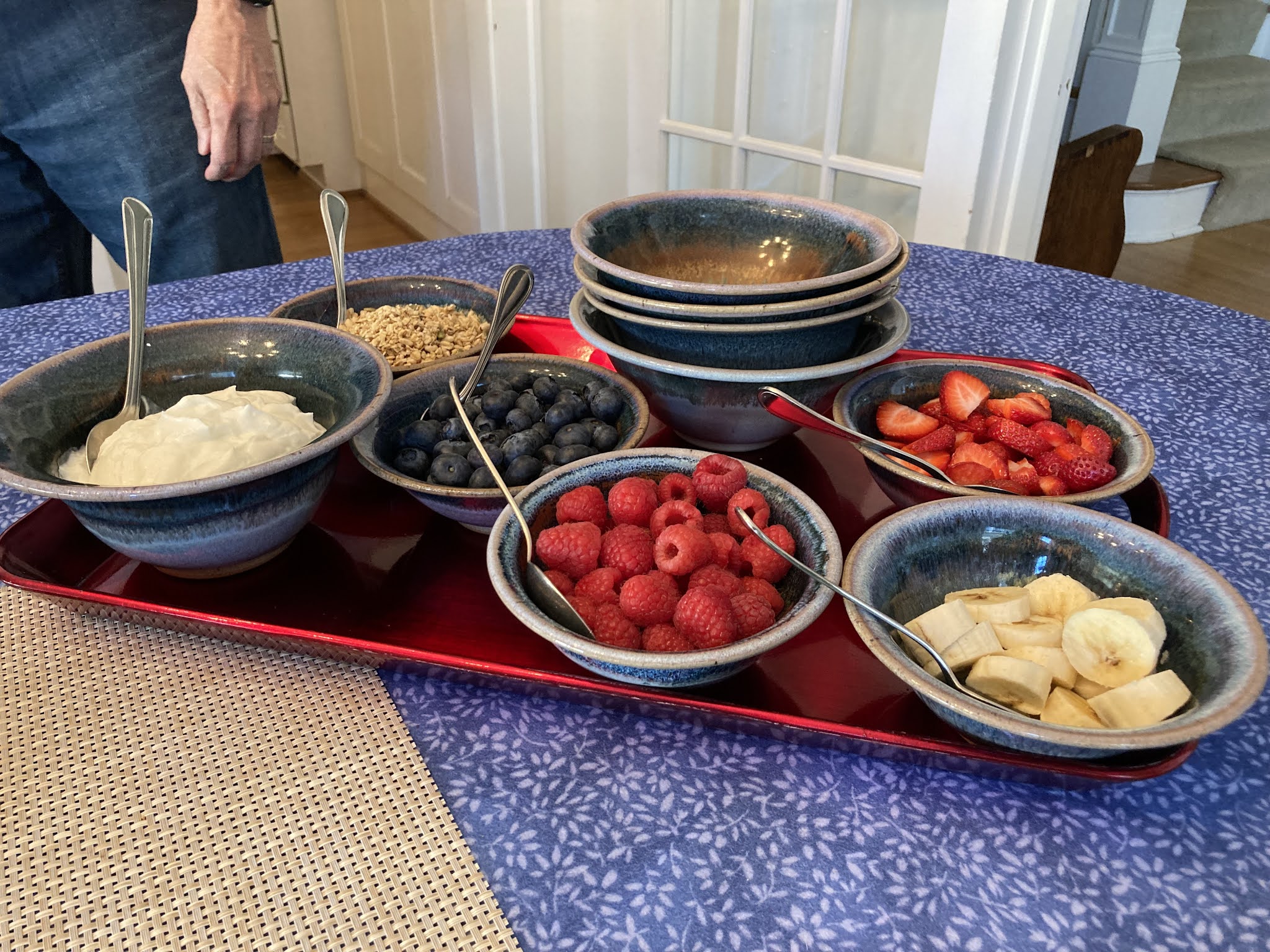
We had a wonderful breakfast. Liz made a delicious spinach quiche along with home-made banana bread and fresh berries with yogurt. And, though the food was amazing, the conversation was what made our visit so special; we felt like we could keep talking for hours. But, we had to be in Spokane before 5pm, so we said our goodbyes and hit the road at 10:30 am.

In Spokane, we had dinner with another set of old friends, Ken & Jamie Ortiz. Ken and Jamie were in Shiloh with Kathy and I in the 1970s and later, Ken worked on staff at Calvary Chapel Costa Mesa while we were working there. In 1984 they moved to Spokane, Washington where he became the Senior Pastor at Calvary Chapel Spokane. Once again, conversation was the main course, and we were some of the last to leave the restaurant.
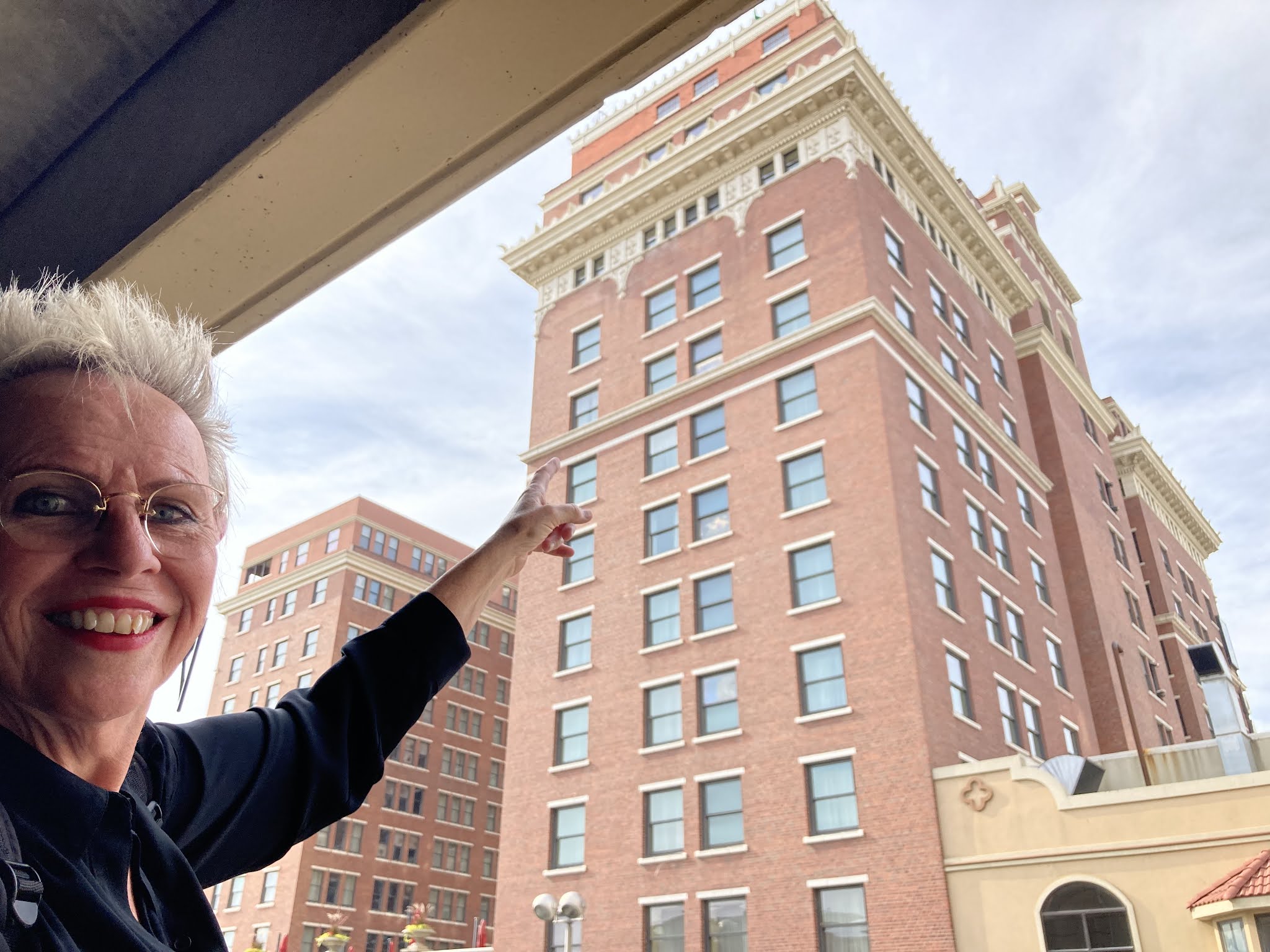
A member of Ken's congregation arranged for us to stay in a penthouse suite of the Historic Davenport Hotel in downtown Spokane.

We'd both seen hotels like this in the movies, but we'd never stayed in one. It was quite an experience. We got back to the room late, and I fell asleep watching the second season of 100 Foot Wave series on HBO. The surfing was not really that great. Give me a regular surfing movie any time instead of a (mock) reality television show. 

This morning, we slept in. (It's 8:00, can you believe it?) I caught up with two days of the blog. Today we're heading to Kalispell, Montana and two nights at Glacier National Park.

Monday, July 26, 2021

Gridley, Lassen and Jacksonville


On Monday morning we were up and in the car by 7:30. On the way out of town, we passed the Starbucks and a big arch that announced "Welcome to Historic Downtown Gridley." We couldn't believe that after driving around the town the night before, up one block and down the other, we had actually missed the downtown section. Unfortunately, the Museum was closed on Mondays. (We couldn't really wait around until opening time anyway.)


The big employer in Gridley, when my Grandmother lived there, was the Libby's cannery. The cannery is long gone, but the town of 7,000 is trying to revive their downtown. We spent a half hour or so, and walked around a few blocks. Kathy found a building housing senior apartments.


In the next block, we found this old building that someone had moved onto a lot. Kathy and I were trying to decide if it was a historical building, or if the lumber was worth enough to try and rehab it. It would be an awful lot of work.

Lassen Volcanoes National Park

By 8:30 we finished fueling up the car and got on the road for Jacksonville, Oregon, near Medford. We could have driven straight through on Interstate 5 in about five hours. Instead of doing that, though, we decided to take the scenic route, through the Lassen Volcanoes National Park. It was a beautiful day and beautiful drive. Once again, we gave thanks for the nice Park Ranger who talked us into buying a yearly National Park Senior pass.


From Gridley we drove to Red Bluff (about an hour), and from there we took Highway 36 to Mineral (about an other hour). There was a more direct route from Gridley, directly up Highway 32, but it was closed due to the Dixie Fire. The drive was nice, though, and there wasn't any traffic.

Unlike Volcanoes National Park on the Big Island of Hawaii, Lassen has no smoking caldera, with annual eruptions. According to the visitor's center, Lassen last erupted in 1914-1917. However it is still an active volcano, the southernmost in the Cascade range.


The most visible evidence of the volcano's activity are the geothermal features that can be seen throughout the park. Unlike Yellowstone, visiting most of the geothermal activity in Lassen requires a bit of a hike, something we didn't have time for. However, there is a boiling mud-pot right beside the road at Supan's Sulphur Works just inside the park. My picture is terrible, but the mud-pot itself is really impressive and a little frightening. I'm sure that after we get back from Yellowstone, it will seem like nothing, though.


The drive through the park is really beautiful. There are creeks, meadows, breath-taking vistas, lakes, and hiking trails. It's also pretty uncrowded. Even in the middle of summer there was little traffic and it looked to us like there were lots of camping places. Back-country camping is also popular, but prohibited right now because of the fire danger. 


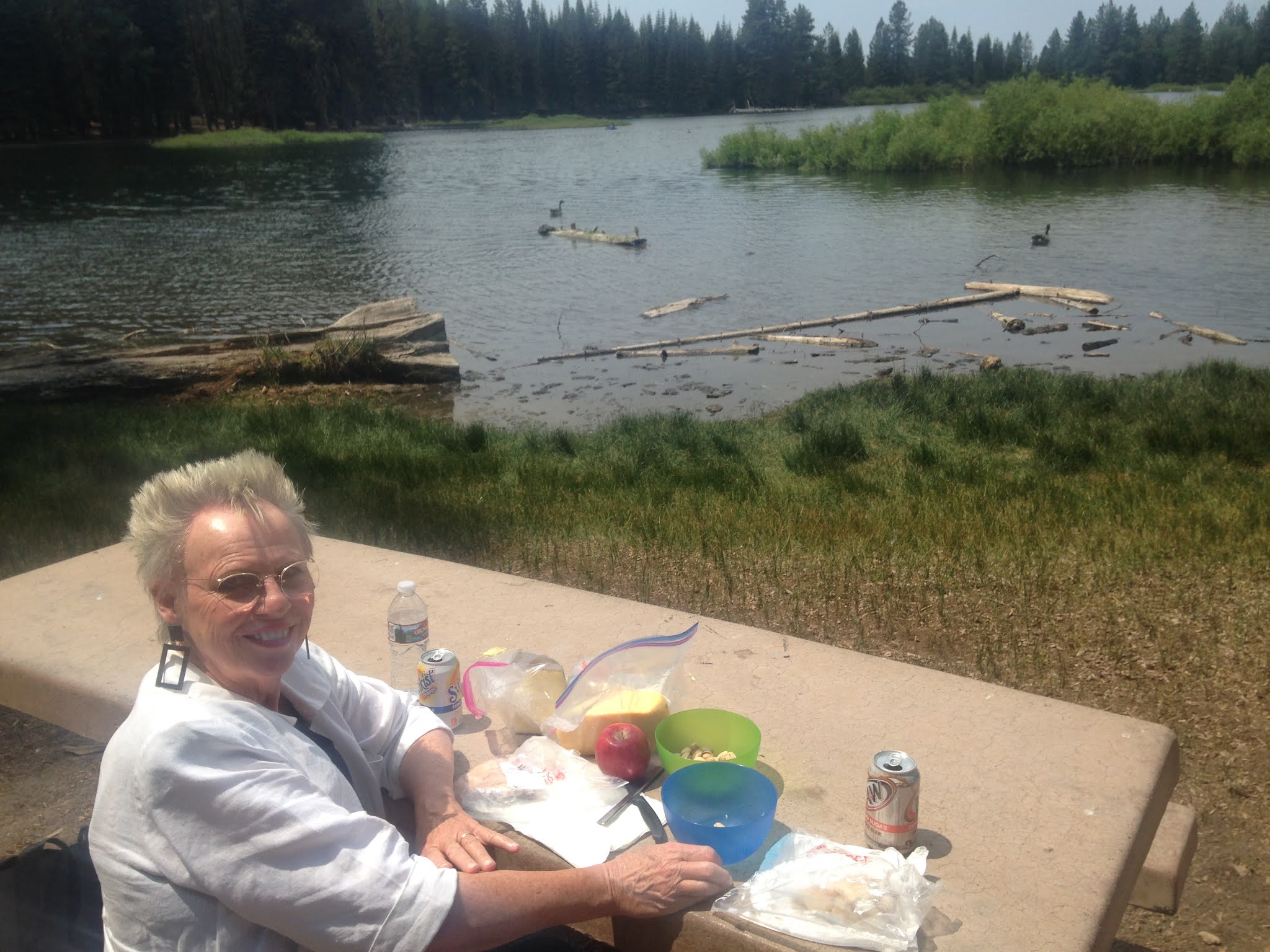
By noon, we reached the north end of the park and had a picnic lunch on the shore of Lake Manzanita. Then, it was back to Redding and up to Jacksonville, right outside of Medford.


In Jacksonville, we stayed at a Bed and Breakfast named the Hummingbird Estates where we got a two room suite for just a little more than what we paid for our motel room in Gridley.


After we checked in, we headed ten miles down the road to Applegate Christian Fellowship and walked around, even though it was after hours.


On the top of hill, overlooking the church, the congregation has built a retreat center. The drive up to the top is a little terrifying; it's quite steep. But the grounds and the cabins are incredibly serene.

Sunday, July 25, 2021

Finding My Father's House

This Sunday morning Kathy and I set out on our summer road-trip to Glacier and Yellowstone parks. Originally, Kathy had proposed that we visit the Grand Canyon, Bryce, Zion and New Mexico in the summer, but I thought that would be too hot. Instead, we went to Arizona and New Mexico over Spring break, where we had unexpected snow at the Grand Canyon. We then planned on visiting the cooler northern climes to escape the summer heat. Now, it looks like we're about to be surprised once again. The local weather said that it was 107F in Billings, Montana today. 

Our first stop was going to be Lake Tahoe to visit some old friends from Shiloh. The Tamarack forest fire and a flu outbreak changed our plans at the last minute. 

Instead of Lake Tahoe, our first stop was the Pacific Motel on Route 99 in Gridley, California. Gridley is actually nowhere near the Pacific Ocean, but it is the home of the Butte County Fair. But that's not why we came here.

What's in Gridley, you ask? On January 13, 1929 my father was born in this house. Since Gridley is about an eight hour drive from our home, we thought we'd make this our first stop. Kathy just traded in her Rav4 and we bought a new Subaru Forester. The problem with the Rav4 is that I didn't fit with my long legs. I could just manage in the passenger seat, but couldn't drive it at all.

There's a lot more leg room in the Subaru and I drove the whole way. I was pretty nervous at first, but it is a really nice car to drive. I think that Kathy is still a little nervous, because when I drive, the car tends to nag a bit whenever I drift just a little bit out of my lane. We stopped at iHop for breakfast, and at Split Pea Anderson's for lunch (the one in Santa Nella, not the one in Buellton. It's always a treat to eat there. 

In the Jack Reacher book I'm reading on my Kindle, Jack finds himself in Leconia New Hampshire, where his father was born. He wanted to see the house his father was born in. Much of the plot revolves around Jack going from agency to agency looking through the records. He got here on a Sunday afternoon, so none of the city offices were open. All I had was an old picture. We drove up and down the streets of Gridley, but never found my Dad's house. I spent some time looking through his records, and called my brother Gary, but was never able to find the address. 

After an hour or so, we decided to head back to the motel and get to bed early. Tomorrow, we're going to stay in Jacksonville, Oregon, and visit Applegate Christian Center. Along the way, we're going to drive through Lassen National Park.

The pictures will be better tomorrow. Promise.

Sunday, April 4, 2021

Putting the Road in Road Trip

For the last week we've headed ever eastward, though northern Arizona and New Mexico. Now, the time for Spring Break has run out, and it's time to get serious about putting the road in road trip.


Alamogordo to Bisbee Arizona

We got an early start leaving Alamogordo. Except for eating and gas, we planned no stops. After about an hour and a half, we picked up Interstate 10 at Las Cruces, New Mexico. Before we got on the freeway, we drove into town and found a place for breakfast.

I, personally, was burned out with green chile (I'm going to spell it like it appears on all the menus I've seen, even though Google Chrome spell check seems to hate it.) A Bite of Belgium offered a break from that. Kathy had quiche and I had a french-style ham and cheese omelet, with two Liege waffles.

The last time we went to Europe, I was able to purchase a special senior citizen train ticket which allowed us to travel through Liege, Belgium. We didn't stay there, but did stop for lunch, just to eat the famous meatballs, which I'd seen on an episode of Travels with Darley. We never got a chance to try Liege waffles, so I was surprised to find them in New Mexico. They were very dense. I think I prefer what we think of as Belgian waffles.

From Las Cruces to Bisbee, Arizona is about 250 miles, partly on the freeway, and partly on State Route 80, bouncing off of the Mexican Border at Douglas, Arizona. This is not (in my opinion) a very scenic drive. We weren't tempted to pull off every few miles for some new roadside attraction.

In the (ghost) town of Apache, we stopped and looked at the Geronimo Surrender Monument, the only point of historic interest we encountered on the trip. This monument memorialized the surrender of Geronimo and the end of the Indian Wars.

Apache is also the site of Apache Elementary School, a one-room schoolhouse with an enrollment (in 2017) of eight students 

We stopped for gas in Douglas (no pictures) and made the last push into Bisbee by 4 pm, where we checked into the San Ramon Hotel which is located just as you enter the old section of town.

We got the second floor corner room, which gave us a wonderful view of downtown. Of course, since we were on the corner of Main and Brewery Avenue, it also meant that groups of people were walking and talking right under our windows until the bars closed at 2 am.

Before eating dinner and walking around town, we walked under highway 80 to the Copper Queen Mine, which had a bewildering variety of minerals and rocks for sale. 

While we were there, the last three mine tours were assembling, putting on their vests, helmets and lights to descend for an hour and a half into the shafts. Kathy and I thought about going, but our limited time (and the 47 degree temperature down in the mine) convinced us that our time was better spent elsewhere. 

We spent the next two hours, first walking through the main section of town, and then climbing up and down the sides of the mountains on which the houses of Bisbee perch. 

It was a pretty exhausting hike (which seems to be a recurring theme for our vacation).

Around 6 pm we went looking for somewhere to eat. Surprisingly, for a tourist-oriented town, the pickings were very slim. The only open restaurant we could find was The Table, right in the center of town. The food was OK, but not exceptional. Now, if we just wanted to drink, there were a half dozen bars and breweries open within the four block area around our hotel.

When we got back to the hotel at 7 pm, I collapsed into bed even before I could write in my blog.


The 4.4 to Yuma

On April 4, Easter Sunday, I woke up at 5:30 am, completely refreshed (what with ten and a half hours of sleep). When we were at the Copper Queen's Lavender Pit yesterday, I had seen a sign for an Easter Sunrise Service in the parking lot. So, I threw on some clothes and headed down the road.

I miscalculated how fast I could walk and arrived a few minutes late, so all of the folding chairs were already filled. That was all right. It was a cool, but not cold morning, and standing was invigorating. The service was a multi-denominational, with churches throughout the town each supplying a reading or a song. I was surprised that I remembered all of the words to songs that I haven't heard for years, such as "Up From the Grave He Arose."

Sunrise was at 6:04 am, so as the service continued, the sun climbed down the walls of the Lavender Pit behind the speakers. Despite the ravages of the mining, it was strangely inspiring.

By the time I walked back to town, Kathy had got us packed for our long second day drive to Yuma.

We turned off the road at Tombstone and drove through town. There were a couple of gunfighters lounging around (really!) waiting, we assumed, for the daily reenactment of the Gunfight at the OK Corral. In was only about 8 am, and we weren't interested in waiting around. I did take a picture of Boot Hill, over the top of the fence. (It wasn't open yet either.)

Mule Mountain Highway 80 joins Interstate 10 in Benson, Arizona. We stopped at the Farmhouse Restaurant for a break and some much-needed calories before the freeway. The food was so good, that I forgot to take any pictures.

As we drove past Tuscon on the freeway, we decided to get off and take a look at the Saguaro National Forest. The eastern (Rincon Mountains) section features an easy eight mile (driving) loop.

Here's a picture of me with my "youth group". Saguaro cacti don't get any arms until they are about 70.

The cactus doesn't mature until it is about 150 years old. I don't know how long they live.

They are extremely susceptible to cold. At one of the turnouts, they had a photograph from 1935, when the forest was thick with cacti. Two years later they had a freeze, and a picture of the same area in 1945 seemed to have about half the number.

We saw only a few flowering plants. The brochure listed a wide variety of creatures which feast off the Saguaro, the other cacti, and their blossoms and fruit. Fortunately, since becoming a National Park, cattle and sheep are no longer permitted to graze in the park.

We left the park around 2 pm, and spent the rest of the afternoon on the long drive to Yuma, listening to Jim Chee still trying to solve the mystery of the People of Darkness. Home tomorrow.